
Founded in 1870 in Detroit, Michigan, the R.L. Polk Company – named after its founder, Ralph Lane Polk – was the premiere publisher of informational directories nationwide. When you held a Polk Directory in your hands, you knew that a trove of information about people, places, businesses, organizations, and local governments was at your fingertips.
Polk directories differed significantly from typical phone books, especially in the early parts of the twentieth century, by sheer volume alone. For one, phone directories only listed those who actually had a phone, which was not always everyone. They did not early on have addresses, especially for those who lived outside of larger cities. And they contained barely any advertising.
A typical Polk directory would list everyone in a household, occupant vocations, and sometimes ages of the children. One did not have to have a phone in the home to get listed in a Polk directory. Oh, and the advertising? It was amazingly detailed.
The one drawback – if that is the correct word – for Polk directories, was that they were not generally published in smaller communities, like Little Falls. The reason being that the smaller the community, the less advertising revenue which could be generated. Little Falls did not see it’s first official Polk Directory until 1976-77.
Besides the typical phone directory – and those did not start being put out until 1908 – what was done in the community, and the county, before that first Polk publication?
Flash back to 1892. The total population of the county was just over 13,000. It has only been not even four decades since the incorporation of the county. Not every municipality had been established yet. It really was a young territory.
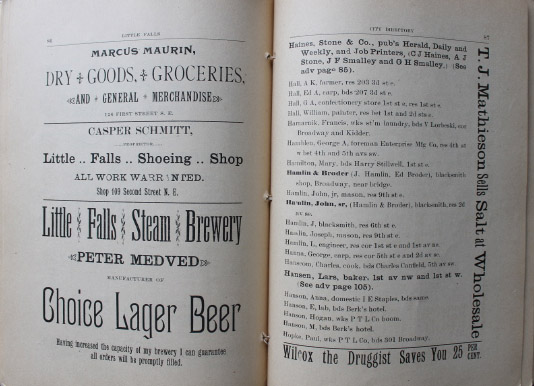
Into that environment stepped the Herald Printing Company, publisher of the Little Falls Herald weekly newspaper. They decided it was time to get the word out. Thus was born the 1892 Little Falls City Directory.

Introduction of the 1892 Little Falls Directory, touting its need and thoroughness.
The Herald did its diligence, and created a publication what covered nearly every aspect of the community, right down to how the street names were to be changed from their original names – which featured trees and letters – into the grid system that we still see to this day. They recapped very village/city official going back to incorporation. They even detailed the community congregations right down to their Sunday School teachers. As for the advertising? If you were running a business in the community, you found your way into that directory.
Unfortunately, the directory’s details basically stopped at the city limits. No listing of farms or other communities in the county.
We can only speculate on how well-received the directory was, but one would guess it was a hit. So of course, another one was done the following year, right?
Well…not exactly. It would be another fifteen years before the next directory arrived.
The 1907-08 Little Falls Directory was this time complied by the Democrat Publishing Company, publishers of the Morrison County Democrat newspaper. Like its predecessor, it covered the city’s residents, the businesses, educational institutions, and municipal governance. And just like it’s predecessor, it stopped essentially at the city’s edge.

We found the plea at the bottom of the title page of the 1907-08 directory particularly amusing.
It took almost another decade for the next directory to appear. This time though, the people listing was expanded into the rural areas, with an alphabetical listing of the rural free delivery (RFD) routes, providing a view into the families who had settled into the countryside.
That directory would sit on shelves until again a decade later, when the 1928 edition came out, this time published by Stanley Simonson, St. Paul Minnesota. As each edition of the directories came out, the details included definitely expanded. The 1928 version built upon its predecessors, this time including business listing from across the county, so that is someone was traveling towards, for example, Pierz, they could find a café at which to dine.

For the first time, directory readers could peruse who all lived in stops like Cedar Valley, Gregory, North Prairie, and Vawter.
Four decades after that first directory was published, and just over eight decades since the formation of Morrison County, the 1938-39 directory arrived. Published by the Wright Publishing Company of Minneapolis, this edition included a fold-out map of the roads and highways in the county. Once again, the details expanded, and one really could find out almost anything they wanted to know about the county’s people, businesses, organizations, and governments.

The fold-out map showed each section number for easy navigating around the county.
The 1949-50 directory shared almost the same attributes as 1938-39. This time though, there would be no successor. The days of the thorough city and county directories had come to an end. During the next several years, smaller versions appeared, but were almost always limited to being business directories.

The start of the business listings from the 1949-50 directory. Notice that under Ambulance Service, they are largely funeral homes.
Finally, in 1976, R.L. Polk stepped in, and published their first Little Falls area directory.
As was expected with a Polk directory, the level of detail was exceptional. An introductory page noted that the information contained in it was based on door-to-door canvassing. One key difference though was that Polk did not reach beyond the city’s borders, as had been the case with many of its predecessors.


In other cities where Polk published, the directories were done on an annual basis. Following the 1976-77 edition, subsequent works came out in: 1980, 1982, 1984, 1986, 1988, 1989, 1990, 1991, and 1993.

The cover of the final Polk Directory for Little Falls, 1993.
As a research tool, the city/county directories provide an indispensable and in-depth look into people, businesses, organizations, and places. They help museum staff fill in information gaps, determine or verify locations, and find names.
One last tidbit – vestiges of the R.L. Polk Company still exists. In 2013 it was purchased by the McGraw-Hill Companies, which now goes by S&P Global Inc, specializing in “financial information, analytics, and energy and commodities intelligence.”
The legacy and impact of all the directories published in Morrison County will long outlive the companies who made them.
A version of this article first appeared in the Spring 2026 edition (V 39, No.2) of the MCHS newsletter. It has been updated here to include the correct full name for R. L. Polk.