Category Archives: architecture

Bill Morgan Book Signing Event May 11, 2013

Central Minnesota author and historian, Bill Morgan, will discuss his new book “Earth, Wood, Stone:  Central Minnesota Lives and Landmarks” at The Charles A. Weyerhaueser Memorial Museum on Saturday, May 11, 2013, at 10:30 a.m. The book is Volume II of a series and covers various aspects of the history of central Minnesota. Among the Morrison County stories featured in the book are Amos and Charles Berry of the First Minnesota Regiment, Vernon Pick, the William W. Warren and MacDougall site and the orphan train. A retired St. Cloud State University professor and long time advocate for the value of our cultural heritage, Bill will share his enthusiasm for local history through his gifted storytelling and talented writing. Books cost $19.95 and will be available for purchase at the museum.

The event is free and open to the public. Refreshments will be served. For more information, contact the Morrison County Historical Society (320/632-4007).

Collections Carousel – Charles A. Lindbergh State Park Shelter and Bridge Postcards

Lindbergh Bridge, Circa 1945

On May 21, 1936, the Little Falls Daily Transcript announced that Charles A. Lindbergh State Park in Little Falls, Minnesota, had received approval from the Works Progress Administration (WPA) for a $23,777 Lindbergh State Park development project. Work was to start the following week and employ between forty and fifty men. The project was to include construction of a “log kitchen shelter” in the picnic area and two bridges, one a replica of the suspension bridge built by the famous aviator, Charles A. Lindbergh, Jr. Named for Lindbergh’s father, U. S. Congressman Charles A. Lindbergh, Sr., the park got its start in 1931 when the family donated the home and 90 acre farm on the banks of the Mississippi River to the City of Little Falls. Initial improvements to the site were focused on clearing the property and securing the home from further damage by souvenir hunters.  (For more information on the Lindbergh family see Morrison County Influentials). Both the log cabin shelter and the bridge exemplify the rustic design and construction that became the signature style of the WPA. Designed by architects H. Nielson and L. Taylor, the cabin was built in 1938 and includes a massive stone fireplace and peeled saddle-notched corner logs. While the bridge was later replaced, the log cabin shelter remains and continues to be used today. The original 110 acre site has expanded to encompass the park’s current size of 576 acres.

The hand-colored photo postcards of the bridge and the log cabin shelter were produced by the Albertype Company of Brooklyn, New York. Founded in 1890 by two brothers, Adolph and Herman Wittemann, the company produced over 25,000 collotype images of towns and cities from across the United States before it closed in 1952. The collotype, or albertype, was a fairly cheap and extremely accurate method for reproducing photographic images through a photomechanical process. Introduced in 1855 by Alphonse-Louis Poitevin, a French photographer and chemical engineer, the process was adapted by other French photographers and quickly became important to the photographic reproduction industry.

Log Cabin Shelter House, Circa 1945

Porch Repair

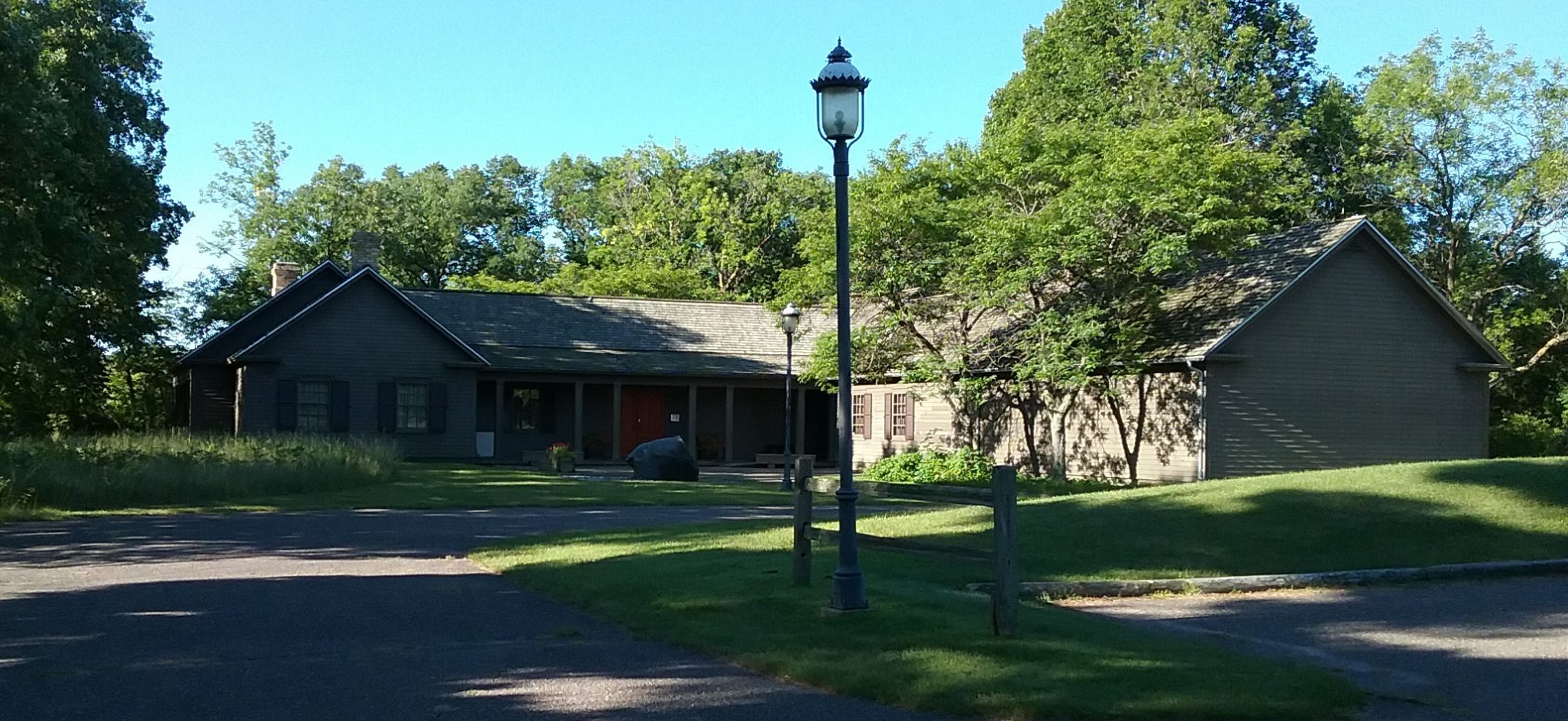
The Weyerhaeuser Museum is having some much needed porch repair done by Maschler Construction, owned by Bob Maschler.

The building is 37 years old and the porch was showing its age with rotten beams, broken trim and salt-eaten cement blocks underneath.

Bob, a meticulous carpenter with Morrison County roots, has been at work on the porch with his assistant since June 28. As of the morning of July 6, the men had stripped off the old wood from the columns and floor, removed the crumbling cement block from below and replaced it, put in a new floor, replaced the rotten support beams, and worked on trimming out the support beams.

(Might they finish today? I’m writing this Friday afternoon, July 6, but won’t publish the post until Tuesday, July 10 because Ann Marie has already posted today. No need to inundate you with too much to read.)

We thought you might appreciate pictures of the week’s progress on the porch, so without further adieu ….

The porch is stripped of its old wood, July 3, 2012.

The porch is stripped of its old wood, June 28, 2012.


A rotten support beam on the porch, July 3, 2012.

A rotten support beam on the porch, June 28, 2012.

A full-length view of the stripped porch, July 3, 2012.

A full-length view of the stripped porch, June 28, 2012.

The cement foundation under the old porch was dug out because it had deteriorated from winter salt, July 3, 2012.

The cement foundation under the old porch was dug out because it had deteriorated from winter salt, July 3, 2012.

The new cement foundation under the porch, July 3, 2012.

The new cement foundation under the porch, July 3, 2012.

Bob Maschler & his assistant finishing the new floor, July 5, 2012.

Bob Maschler & his assistant finishing the new floor, July 5, 2012.

New support beams and floor on the porch, July 5, 2012.

New support beams and floor on the porch, July 5, 2012.

Close-up of new support beams and floor, July 5, 2012.

Close-up of new support beams and floor, July 5, 2012.

Bob and his assistant installing the decorative boxes around the support beams, July 6, 2012.

Bob and his assistant installing the decorative boxes around the support beams, July 6, 2012.

Bob Maschler hard at work, July 6, 2012.

Bob Maschler hard at work, July 6, 2012.