2010 Dot.Org Award Winner

This website won a 2010 Dot.Org Award from the Minnesota Council of Nonprofits because of the organization's use of free & very low cost widely accessible online applications in building it.

Friends of Dewey Radke Website

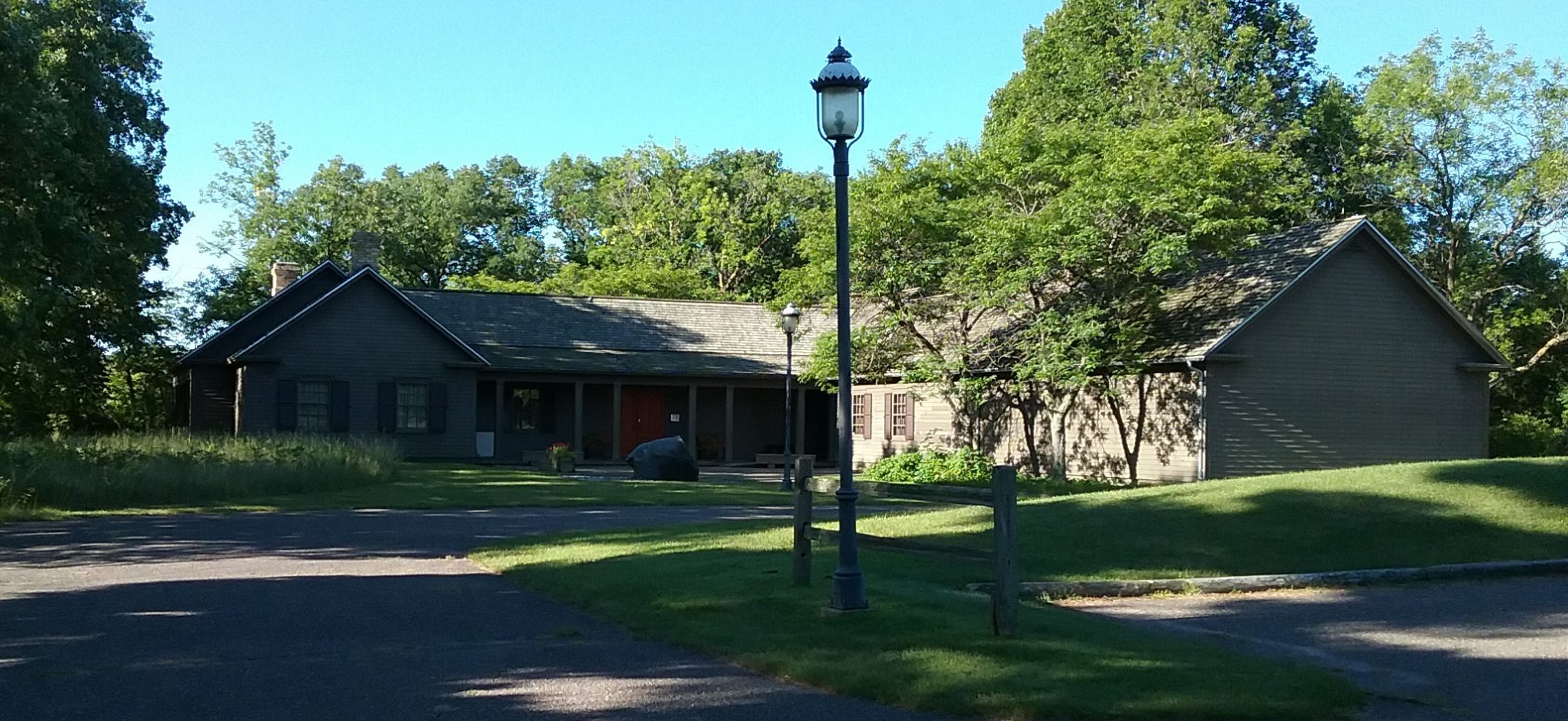
The Friends of Dewey Radke House organization has created a new website to announce its activities. It is at http://fdrh.wordpress.com/. I will add this link to our Online Resources page, under the Attractions heading.

-Mary

Gov. Tim Pawlenty’s Great-Grandmother’s Pickle Recipe

A local group of Red Hat Society ladies paid a visit to the museum this morning. Upon seeing our small display of pickle recipes, one of the group members, Judy (Cota) Cantleberry, offered to provide us with her grandmother’s dill pickle recipe. Judy’s grandmother, who also happens to be the great-grandmother of Governor Tim Pawlenty, is Mary Pawlenty. As written by Judy, here is Mary’s recipe, which is cherished by the family:

13 cups of water
1 quart of Cider Vinegar
1 “scant” cup of salt

Boil together 5 minutes.

Pack jars with whole small cucumbers, 3 or 4 cloves of garlic and lots of dill. Cover with hot liquid and seal – put in boiling water bath 5 minutes.

If you’ve never made pickles before, here is a complete article on the canning process by Jackie Clay at Backwoods Home Magazine: http://www.backwoodshome.com/articles/clay53.html

Thanks, Judy, for sharing your grandmother’s recipe, and thanks to the Red Hat Society ladies for being such a fun group.

-Mary

Genealogy Information

Several times this month something has happened while I was helping researchers, and while talking with Ann Marie this morning about it,  she thought I should share it with you.

It’s about names…first or last, it doesn’t matter.  Researchers have come in looking for someone, fill in a research form with the name, and ask for newspapers to search through as they don’t have an exact death date.  That can take a very long time, so before I give them the newspaper I usually ask them if they have searched our family files.  If yes, I will give them the newspaper but then I check to see if I can find a death date in our Obit Index or if not check on the website www.mnhs.org.

In the last case, I couldn’t find the death recorded, that is, as it was given to me.  I asked if the person’s name could be something else, as it sounded like a nickname to me, and they were positive the name was like they had given to me, it was a parent’s name.  I took the research a little further and called the Recorder’s Office,  and Eileen was so helpful.  She found the person from just the last name and a death date of month and year only and it matched with all the information on the research form…except the first name.

When I gave this information to the researcher she was stunned, then said she never knew that. So when you’re doing your research don’t be so sure about names, check different spellings, nicknames may be something else, even if you only knew it as such and maybe, just maybe you may be “stunned” as well.

Big Ideas for Small Museums Coming Soon

Small museums often don’t have time to root around for resources that will help them in their work. The Small Museums Committee of the American Association for State and Local History has been working on a ginormous resource list with assistance of small museum people all over the United States. The Committee, on which I am a member, has also been deciding how best to get information about these resources out to small museums. One of those outlets, a quarterly email,  will be available shortly. Below is the press release concerning the quarterly email with information on how you can subscribe.

- Mary

—–

Big Ideas for Small Museums is a quarterly e-mail just for people who work in small
museum. The Small Museums Committee of the American Association for State and Local
History (AASLH-SMC) intends this new communication to share resources that are
pre-tested approved by actual small museum professionals. The articles will be
brief and practical – giving you the shortcuts you need when you don’t have enough
time, money or people. (And what small museum does?)

To receive this resource, you’ll need to join the AASLH Small Museum Affinity Group.
The Affinity Group is not a membership organization and there is no fee to join. You
will need to create a username and password and share your basic contact information
- but this will only take you two minutes. Go to http://www.aaslh.org/SmallMuseums.htm and click on the “join the Small Museums Affinity Group” link at the top of the page. And while you’re there, you might check out the other resources offered by the Small Museums
Committee, including…

* AASLH-SMC’s definition of a small museum
* Small Museums Needs Assessments Executive Summary
* 2009 Small Museum Luncheon Keynote Address by Marsha Semmel, IMLS

The first Big Ideas for Small Museums will appear in your inbox in September, but
join today to ensure you don’t miss a thing!

Atlas of Historical County Boundaries

Another online resource has come to our attention, this one via the Minnesota Historical Society’s Local History News e-newsletter.

The Atlas of Historical County Boundaries was created by the William M. Scholl Center for American History and Culture at The Newberry Library in Chicago, Illinois. The result of years worth of work, this online atlas shows the historical creation and changes of every county in the United States of America, no small feat considering there are currently over 3,000 counties and quite a number of counties have gone extinct over time.

The Atlas, which is free to peruse, contains both text and maps showing the fluidity of county boundaries between the early 1600s and the end of 2000. The Atlas was created using “the session laws of the colonies, territories, and states that created and changed the counties.” (You don’t get more primary than that when looking at research resources.)

An unusual feature of the website is that it is considered complete as it is. At the top of the “About the Project” page, the following line appears:

The Atlas of Historical County Boundaries project was successfully completed in June 2010. No further updates from the project are anticipated.

Because definitive dates (from the formation of the first county through the end of 2000) were chosen for the map project, once the data had been gathered, digitized, and uploaded to the internet, the website could be declared finished once the project parameters had been achieved. That’s not typical for most websites.

Navigating the Atlas is fairly intuitive, so have a look around and enjoy seeing how the counties’ boundaries have changed. (Of course I’ve looked up Morrison County already. Fascinating, just fascinating.)

I’ve added a link to the Atlas on our Online Resources page, under the Federal / National Information Resources heading.

- Mary

Newspaper Research Tip

I’ve been researching the construction of the Highway 10/371 bypass around Little Falls, patiently flipping through each issue of the Little Falls Daily Transcript between 1969 and 1971. When I got to the last issue of 1971, I noticed that it includes a summary of the major local stories for the year by month. I’ve seen these summaries before and thought they would be useful for narrowing down a search, but I didn’t think of it until I had gone through a few years’ worth of newspapers. Live and learn.

And learn from my mistake. If you’re trying to pin down a major past story and want to save yourself searching time, start with the summary in the last newspaper of the year.

Collections Carousel – The Odd Shop Bag

Bag (front) - The Odd Shop of Little Falls, Minnesota, circa 1955

The Odd Shop got its start in 1929 when Ida Caroline McCauley and her niece, Clara (McCauley) Guerin, organized the Guerin McCauley Company.  The company first purchased the former Levis Stationery and Confectionery Store at the corner of First Street and Broadway in Little Falls, Minnesota.  At the time of purchase, the Levis Store offered a line of items that included books, stationery, cut flowers, Kodaks, Kodak finishing and what it referred to as a “quality soda service at our up-to-the-minute fountain” (Morrison County Directory, 1928).  Ida and Clara operated a business at that location for only a few months, as a fire destroyed both the building and stock in April of that year.  The following month, they purchased the Venners Confectionery and Lunch Room at 112 Southeast First Street in Little Falls and named the store The Odd Shop.  The Odd Shop later added a gift line and “funeral pieces” (WPA #1075 – Biography of Ida Caroline McCauley).

Both Ida and Clara had experience in retail prior to forming the Guerin McCauley Company.  Ida learned the millinery trade after leaving school and worked in Wisconsin and Michigan for several decades.  In Ironwood, Michigan, she worked at the Davis Fehr Company for twenty-eight years, serving as a buyer and manager.  After graduating from the Little Falls High School in 1904, Clara worked at the Corbin Jewelry Store in Little Falls for more than thirteen years.

The Odd Shop remained in business for over thirty years.

Bag (back) - The Odd Shop of Little Falls, Minnesota, circa 1955

Legacy Funding Input Meetings

In November 2008 the citizens of Minnesota voted to pass the Clean Water, Land and Legacy Amendment as part of the Minnesota Constitution. The Legacy Amendment, as it’s called, provides for a .375 percent increase in the Minnesota sales tax in order to fund projects related to the environment and culture (arts, history, libraries, etc.) throughout the state.

The Minnesota Historical Society (MHS) was appointed to administer the history portion of the Legacy fund. MHS received input from the Minnesota History Coalition and citizens via a number of meetings held throughout Minnesota in 2009. The result of this planning was the Minnesota Historical & Cultural Heritage Grant program, with the first grants being awarded late last year.

Now that the first fiscal year of funding has passed, the Minnesota History Coalition is again seeking the input of historical organizations and citizens from around the state in order to evaluate how the grant program is working. Seven meetings have been scheduled at the following locations:

*   F&M Community Bank, Preston, July 14, 9:30 a.m.
*   Hjemkomst Heritage Center, Moorhead, July 20, 1:30 p.m.
*   B’nai Abraham Synagogue, Virginia, July 21, 1 p.m.
*   NEW! Little Falls Public Library, July 22, 10:30 a.m.
*   Cottonwood County Historical Society, Windom, July 27, 10 a.m.
*   North Star Museum, North St. Paul, August 2, 9 a.m.
*   Edina Historical Society, August 3, 1 p.m.

The meeting in Little Falls is a late addition to the schedule, having been added at the request of State Representatives Al Doty and John Ward.

The public and representatives from historical organizations are invited to attend these meetings to learn more about what has been accomplished through the grants program thus far, and to offer feedback on the program. To attend, please RSVP at the following link:

http://mhs.informz.net/survistapro/s.asp?id=3482

RSVPs may also be made to John Fulton at john.fulton@mnhs.org or 651-259-3467.

“Year by Year” Events in History

I had a call this morning from a researcher wanting a timeline of events from the past several decades. The researcher didn’t want a timeline of Morrison County events, but a more general list of important world events. While many of the world’s events appear in the pages of our local newspapers, that would involve a lot of searching, particularly when these sorts of timelines have been compiled before. I was sure I’d find something suitable online, and I did.

Check out Year by Year: 1900-2010 from infoplease.com. The site allows you to look at each year individually, or a listing by decade. It also offers some topical timelines, such as World History, Tallest Buildings, and Millennial Milestones.

The site does not cover every event in history, but it’s great for an overview of major events.

Are there any timeline websites you use in your research? If so, please share them with us in the comments.

-Mary

Online Resource for Early Minnesota Maps

While doing research for an upcoming newsletter article, I found another interesting online resource. This one shows digitized images of early Minnesota maps down to the township level.

The site is Original Public Land Survey Plat Maps of Minnesota. Click on View the Collection in the left sidebar and follow the instructions given for viewing the maps.

Happy researching!

-Mary