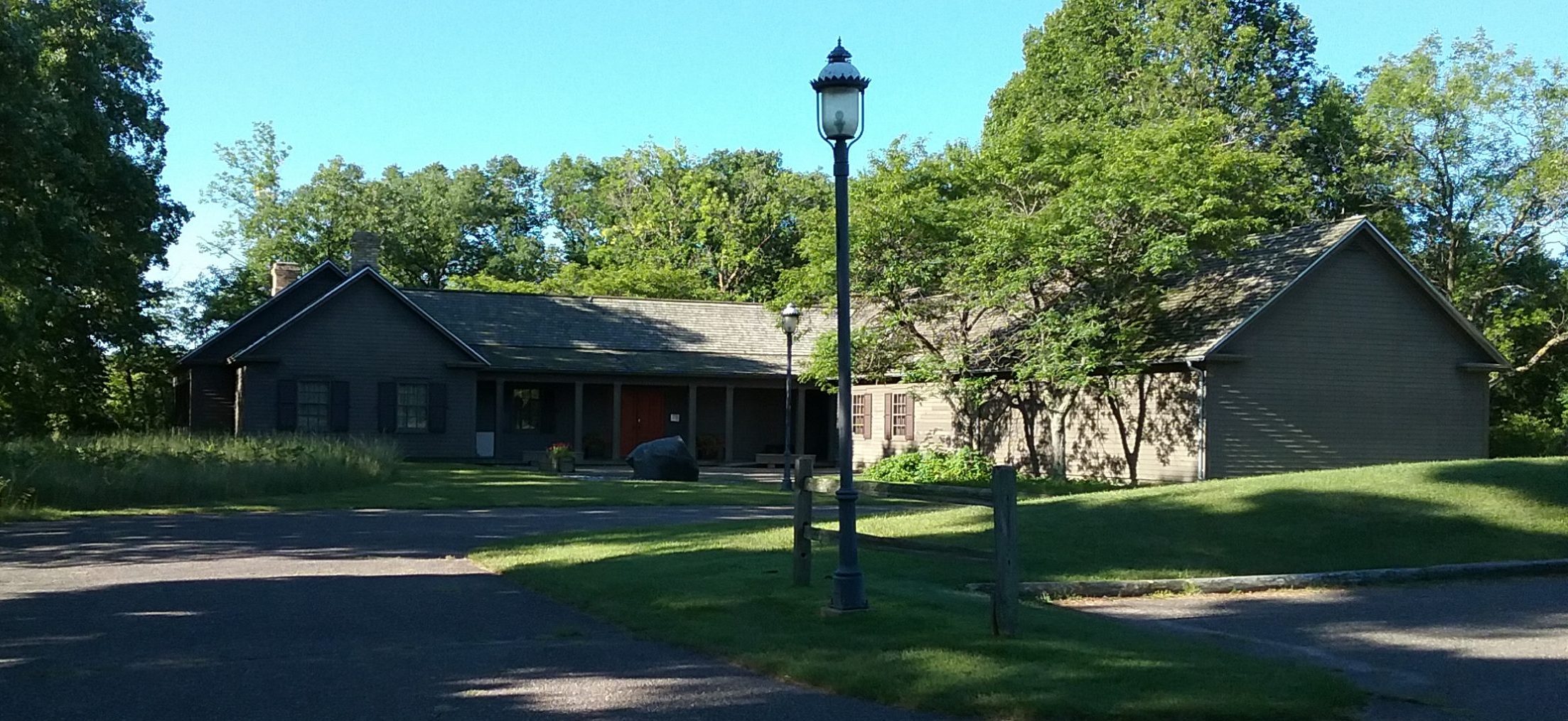

On October 16th, 1805, Lieutenant Zebulon M. Pike halted his expedition up the Mississippi River to build a stockade on the shore of Swan River where it emptied into the Mississippi River. For two months, his party resided 3 miles south of where the Charles A. Weyerhaeuser Memorial Museum stands today to prepare for not just the upcoming winter but the rest of their journey. Pike kept daily logs of the voyage, chronicling the environment around him, the actions of the group, and his personal feelings of the people and experiences.
With the anniversary of his time at the Morrison County encampment upon us, why not spotlight this pit stop of the journey by chronicling Pike’s daily journal entries, as found in the 1894 from the several weeks they camped there? His records will take us back to an era before the land was cultivated for industry, when elk and bison roamed freely, without fear of hunters with weapons too weak to take them down. Let’s put ourselves in the shoes of explorers in an unfamiliar setting that we now call home without having to discern 200-year-old prose.
Beginning October 16th, a week of Zebulon’s journals will be published on our website every Friday, detailing the thoughts and actions Pike wrote down 221 years ago. They will all be found on this page, with the latest update featured at the top.
A note: This is The Pike Show, but I don’t want to call him Pike the whole time. He rarely talks about the other party members besides what they do with him (or their mistakes), making most of the other men indistinguishable. His name is Zebulon, which is really cool! Like, that’s one of the FEW great things about him, and I’m pretty sick of the word “Pike” at this point. He will also be called his full name, Zebulon, Zeb, Zebby, and the Zebster.
Week 3, October 30-November 5, 1805
After the explosive day that was October 29th, the next day was, in Zeb’s words, “Nothing extraordinary,” (109) as the party worked as usual. October 31st, however, seemed to be a dark day for him, at least mentally. Two of his boats were brought up from the river, “and turned them over on each side of the gateway, by which means a defense was made to the river,” (109). Pike makes some odd remarks at the possibility of an attack by Native Americans, specifically that it would amuse him, just before describing the overwhelming weariness he feels.
Rather than forging ahead, leading men north on a once-in-a-lifetime expedition, they are stopped, settling, preparing for lands and people they have not seen and do not know; and for the first time, Zebulon is uneasy. He packed his books away that night, and it left him vulnerable to spiraling over what the wilderness can hide. Pike said, “Found myself powerfully attacked with the fanatics of the brain called ennui, at the mention of which I had hitherto scoffed…I was like a person entranced, and could easily conceive why so many persons who had been confined to remote places acquired the habit of drinking to excess and many other vicious practices, which have been adopted merely to pass time” (110).
On November 1st, Zebby learned they’d have to wait a few more days for another canoe to be finished, so he focused his energy on hunting for the remainder of the week. That day, he and six men traveled down the river, about to what is now the southern tip of Two Rivers township, where they’d seen herds of elk and buffalo. They all went out to hunt once arriving in the afternoon, but only Sparks left with anything, just one doe. But would that discourage Zebulon? Could anything discourage the Zebster?
For the rest of the week, all Zebulon Montgomery Pike wanted was to kill an elk for the first time. The plan was that if he found an elk, he’d track it for a couple days before killing it; a plan that Zeb then called a “foolish resolution,” (110). Accompanied by Private Miller—whom Pike described as having an “obliging disposition [that] made him agreeable in the woods,” (110)—he set out on his mission and quickly found evidence of a large elk herd that recently passed by. They tracked them until finally seeing a long line of elk, with large bucks at the front and back of the line. Pike and Miller followed the herd the entire day without ever getting a good shot on any of them. At one point, Zeb told Miller to shoot at the herd which only made them run farther away from them. Zebulon never explained why he wanted him to do that, but later said he didn’t attempt to shoot any more deer they passed to not startle the elk.
The rest of the November 2nd entry—because it is STILL the same day—was more mishaps in pursuit of elk. At one point, they’re tracking a doe, then lose her, but come upon three elk grazing. Zeb recalled shooting one but they all ran off before he could catch it. Some time later they found a buck deer lying on the ground and Pike shot it right between the eyes. He approached it and put his foot on the antlers to get a view of his shot, but then the buck bounced back up, made it a few steps before falling back down. Zebby and Miller waited a few seconds before approaching again, assuming the buck was down, but no. He got up again and ran off, and the pair pursued it thinking it’d collapse for the last time, but he never did. Having long lost the one injured elk from today, they returned to the large herd to see if it came back to the group; they never found it. Zeb shot another elk in the body, hoping to wound it enough to drop, but their musket balls were too small to severely harm it.
At the end of this long, exhausting, and fruitless day, Pike and Miller camp at the head of Platte River, only a mile away from the large elk herd. Zebulon reminisced on the trials he faced in his pursuit of an elk, from failing to track any injured animals, to his weak ammunition, and only having wounded five animals all day. He [FINALLY] finished the day’s journal with a line so poignant, it could be the thesis statement of the Mississippi River expedition: “Our want of success I ascribe to the smallness of our balls, and to our inexperience in following the track after wounding the game, for it is very seldom a deer drops on the spot you shoot it.” (111).
Piller [Pike and Miller] woke up early on Sunday, November 3rd ready to try and kill an elk, and Zebby wrote genuinely the hardest to follow hunting journal I’ve ever read; he was a terrible writer. They fell into a loop of following a herd, shooting one, then losing it. Their musket balls weren’t big enough to take either the nearby elk or buffalo down, so they wind up watching them pass or wounding some but never culling one. That is until sundown, when Zeb and Miller were waiting near a lake, an elk herd was heading towards them. They silently watched as two curious bull elks broke off from the group and, unknowingly, approached the hunters. Pike aimed and shot at one of the elk, hitting its shoulder. It only made it 20 yards before falling down dead.
He did it! Zebulon Pike killed an elk like he wanted to! Probably his only true success on the expedition! Pike said, “This was the cause of much exultation, because it fulfilled my determination,” (112) and it was also their first time eating in two days. After dragging half of the elk—the other half eaten by wolves—to their small camp about a mile away, feasted, and rested. They prepared to return to the encampment early the next morning, repairing their shoes to march back to the Mississippi River.
Realizing how far away they were, Zeb instructed Miller to guard the meat while he returned to send men back for him. He hadn’t made it very far before he found a herd of about ten elk. Pike shot one that fell, got back up, and ran away, so Pike tracked him for about five miles before giving up. He retreated to the Platte River where he saw a deer standing on the opposite bank. Taking the golden opportunity before him, Zeb killed the deer and while he “was taking out the entrails,” (112), another deer showed up, which he killed with his last musket ball, “and then only could I kill!” (112) [I have no idea what he meant by this so I included it in case anyone else had an idea what he meant by “only could I kill” when he’s out of ammunition].
Zebby returned to the encampment at dusk on November 4th [underclothed after leaving some clothes with the dead deer “to scare the wolves,” (113)] to the party’s delight. The men, after not hearing from Miller or Pike for two days, assumed they were killed by nearby Natives, who they’ve heard shooting and seen their fires. At the end of this busy, busy week, Zeb sent some men away with a canoe to hunt up river and went with two others to retrieve the meat and pick up Miller on the way. And the week is over!
Week 2, October 23-29, 1805
Snow kept falling when the party awoke on Wednesday, October 24, but the work wasn’t over yet. They raised the second blockhouse through sleet and snow under Zeb’s watch; the party were now able to move all their items into the now completed huts. One of the hunters, Bradley, was sick so Pike and the other hunter, Sparks, separated to hunt themselves. They each returned to camp with two deer, one goose, and one “pheasant” (pheasants are not native to the region and were brought to the US in 1905. What bird this actually was, we may never know).
On the morning of the 25th, Zeb commanded some men to accompany Sparks to retrieve the game he killed, but none of them returned. When Pike discussed this with the party’s interpreter, a French man who had some experience in the region, he believed the men were killed by Natives. Pike dismissed this in his journal, explaining he believed his interpreter “to be a coward,” (108) and spent the next couple days preparing the canoes and cargo to depart. To Zebulon’s [I’m assuming here] chagrin, he failed to cull any wildlife while his hunter returned with three deer. That’s pretty rare for him.
After a successful launch of canoes, two were brought to the head of the river and filled with cargo on October 28th. They were in the river under watch of a guard, since Pike intended to leave he intention to embark later that day, but after about an hour, the canoe containing Pike’s personal baggage and ammunition sank. To attempt to save as much ammunition as possible, Pike spread the cartridges on blankets in front of large fires. When describing the event, Pike said, “At that time I was not able to ascertain the extent of the misfortune, the magnitude of which none can estimate, save only those in the same situation with ourselves, 1,500 miles from civilized society; and in danger of losing the very means of defense—nay, of existence,” (109).
Well, Pike spent most of October 29th attempting to save as much ammunition as possible. When he tried to dry the gunpowder in pots [near fire, in a tent], it blew up. He blew up the gunpowder as he was drying it, destroying a tent and nearly killing some of his men. They lost 5 dozen out of 30 cartridges, but were able to make a dozen new ones with old wrapping paper. Surely, this mistake will never be made again, right? Right?
Week 1, October 16-22, 1805
When the party awoke on the morning of Wednesday, October 16 just south of the Two Rivers streams, they were greeted by the first snowfall of the season, a bad sign for a northern expedition. The snow continued all day as they pushed themselves up the river, numbing the hands and feet of the men in only four hours. They stopped and set up a temporary camp as the men’s physical condition became too obvious to ignore. The only sergeant had broken a blood vessel and reportedly vomited close to two quarts of blood, and one of the corporals “evacuated nearly a pint of blood when he attempted to void his urine” (pg 105). On top of that, the boats floating in the river sprung leaks and filled up with cold water, so Pike ordered three men to scoop it out.
It was only at this point that Zeb finally considered the well-being of the men working for him. He noted that he had an obligation to leave the ill men behind to continue the journey (something he’s already done on the trip), but he realized, “If I had no regard for my own health and constitution, I should have some for those poor fellows, who were killing themselves to obey my orders” (105). After their short rest, Pike walked the party back to their boats resting on rocks beside the river—pointing out, again, that he is “obliged to leave them”—to announce that they would leave some of their men and boats at their new camp as the rest continued up the Mississippi River. Zeb said of the reaction, “This information was pleasing, and the attempt to reach the camp soon accomplished,” (105).
Besides the well-being of his party members, Zebulon explained some positives about their stopping point near what is now Swan River, like the scenery, the abundance of trees for boats and huts, a large wildlife population, and the fact it was just a good place to set up camp. After unloading and securing their cargo, Pike followed Swan River to search for good boat-making trees and came upon a small herd of deer, killing one buck.

He ends this day’s (yes, it is still October 16th) journal reflecting on how leaving men at this camp will work out really well for him on the return trip. With the quantities of game around, his men would amass plenty of food for the return trip. Zebby then admits he’d leave only one—“continually employed”—hunter at the encampment to not just hunt but also to be responsible for preserving the meat. His final thought was that they were 233½ miles above St. Anthony Falls, which is over twice the actual distance.
For the rest of the week, Pike gave shorter journal entries describing the work he and his men put in to put together their encampment. It was still snowing the next day, but the party began cutting down trees for repairing and building canoes. Zeb focused on hunting on the 17th, killing four bears while his hunter companion killed three deer. On Friday the 18th, every hand was put to work chopping logs for their huts and boats. With only two felling-axes and three hatchets, the party cut 60 logs in a single day, which “was pretty good work” (108), according to Pike, and I am not knowledgeable enough to refute.
They raised one house and almost completed one canoe by October 19th, but Zebby spent most of the day writing letters and making arrangements for if he were never to return, which is something he seems to think more about while on Swan River. The labor continued on Sunday, October 20th, and that night they saw the prairie on the opposite side of the Mississippi River on fire. Zeb assumes the fire was made by a group of Sioux but refrains from seeking them out as to make their encampment more defensive.
Zebulon had a tough time hunting the last two days of this week, going out both the 21st and 22nd but coming back with nothing. He reasoned on the 21st that he didn’t want to shoot small game, and then on the 22nd he saw many deer but failed to kill one. When Zeb returned after a second day with no game, he found his men lazing around not working on the canoes or huts. He decided to leave hunting to other party members and instead supervise the building work. That night, at the end of their first week stationed in what is now Morrison County, Zebby recalled spending the night laying out in the pine woods with Private Miller.